Showing posts with label swimming pools. Show all posts

Monday, September 9, 2013

Meditating on lines and stripes at the pool

Looking at an exhibition of contemporary textiles at the Sturt Gallery in Mittagong recently made me think of lines and stripes at pools. Called Parallels, artist Barbara Rogers explored the "diversity and language of the stripe; the simplest of all patterns..."


Some of her silk textiles reminded me of particular pools especially ones she created in shades of green and blue.


When I saw this one hanging in the gallery space I immediately thought of the Bondi Icebergs.


But it also reminded me of lanes and ropes at chlorine pools.

Valley Baths, Brisbane.
Lines and stripes are everywhere at pools.


Splashed across an entrance.  

Cooma Pool
 In the design of buildings.


In the towels that hang around the edges of the water.  

Bondi Icebergs Pool
And rest on rocks and concrete waiting for their owners to emerge from the pool.
Wylie's Baths, Coogee
They're on boardwalks and grandstands.
Moree Artesian Baths
 And on seating and stairs.

Wylie's Baths, Coogee
On the doors of change rooms like these multi-coloured stripes at the Annette Kellerman Pool.


Sometimes they are fleeting like the shadows that fall on surfaces around a pool.

Northbridge Baths
 Or in the colours reflecting lines in the water in the pool.

Spring Hill Baths, Brisbane

And occasionally they form naturally in the underwater beauty of an ocean pool.

Wylie's Baths

Friday, May 4, 2012

Marrickville Council makes decision on Petersham Pool

At the 17 April Marrickville Council meeting, a decision was made on the future of the Fanny Durack Aquatic Centre aka Petersham Pool.


The good news is that there will continue to be a pool in Petersham Park. At the meeting it was resolved to tender the works, closing the pool over the 2012-13 season (depending on the results of the tender process) and reducing the length from 33 metres to 25 metres in line with FINA standards.


Part of the motion carried at the meeting strongly restated Council's commitment to building a new pool. Point 5 of the motion supported extension of the opening hours of the new pool from the start of the September school holidays to the end of March or the end of the Easter school holidays, whichever is the latter.


So while it's the end of the 33-metre pool, I am happy that Council has made a decision to build a new pool.  Hopefully the relaxed atmosphere of the current centre will continue at the new one. Council has advised that the exact dates of the re-opening will not be known until the successful tender is awarded. I will keep you posted on the outcome of the tender process in the coming months.   To read the motion approved at the 17 April meeting click on the minutes and scroll to page 6.

Saturday, February 25, 2012

In the deep end at almost 80-year-old Enfield Pool


Fear, that's what I feel, just for a moment when the depth of the water in a pool drops suddenly. I experienced this the other day when I visited Enfield Pool for the first time. I was swimming along and then all of sudden a line appeared across the white tiles and the depth dropped from one metre to three metres.  A bit further along I was in even deeper water with the bottom of the pool five metres below.  I think it is the suddenness of the drop that startles me.


I had the same experience at North Sydney Pool and more recently at Maryborough Pool in the Central Goldfields area of Victoria. What connects these pools is that they were opened between 1933 and 1940. North Sydney and Enfield share the same architects’ Rudder and Grout, who also designed Bankstown (1933) and Granville Pools (1936).


The reason for the five metre depth was because they all originally had diving towers.  At Enfield Pool, Sydney's first Olympic-standard chlorine pool, there is an original poster from the early days advertising diving lessons with Harry Tickle. “Diving and swimming taught scientifically by Harry Tickle, ex-Australian and NSW Diving Champion,” the poster says. There are also old photos of the Australian High Tower Championships that were held there in 1954-55. Looking at the height they were diving from I can see why the pool had to be so deep.


When I used to swim at North Sydney Pool during the mid to late 1970s, only the 1-metre springboard was still in action. Although never a great diver I remember going in a couple of diving events at school swimming carnivals. After awhile I gave it away and concentrated on the swimming races, leaving the diving competition to more skilled competitors like our friend Cathie-Anne.


There's not many diving boards left at pools these days as they have become Occupational Health and Safety (OH and S) issues. At Northbridge Baths where I swam as a child, the tough boys hung out near the diving board.  They’d lie on the concrete with their bikini-clad girlfriends and smoke cigarettes. Then they’d have competitions to see who could do a bomb off the bright blue springboard and get closest to the concrete wall without hitting it. If my memory serves me well there was an accident or two?

The area where the diving board used to be at Northbridge Baths.

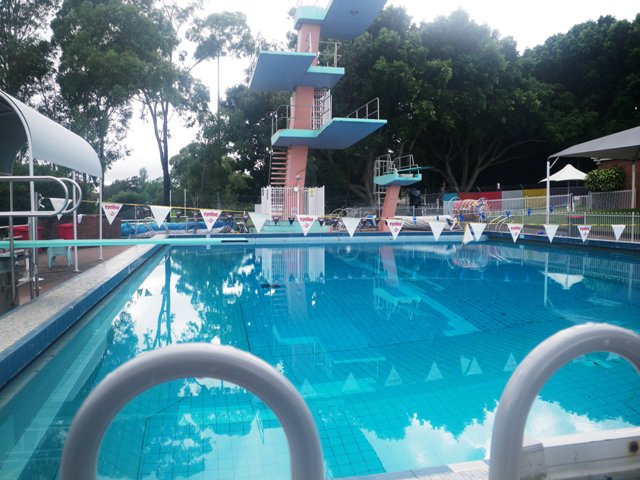
Leichhardt Park Aquatic Centre, which was opened in 1960, still has its diving tower because it’s in a separate pool. It is strictly controlled and only open at certain times. A year or so ago when I was at the pool with my now 13 and 11-year-old nieces, the older one became fixated with diving off the tower. When it eventually opened she couldn’t get up there quick enough. Her sister and I were a bit more tentative. I eventually jumped off the three-metre platform but I can’t say it was a pleasant experience. My niece, on the other hand, enjoyed it as she was relaxed and that’s what it’s all about. My younger niece spent an hour jumping and diving off the one-metre springboard and had a very enjoyable time.

Friday, March 4, 2011

Austinmer's double ocean baths


The Illawarra area, south of Sydney is blessed with many beautiful ocean baths. Between Coalcliff in the north to Shellharbour in the south there are around 24 pools built into rock faces by the sea.


One of these beauties is the double ocean pool at Austinmer. With my good friend Marg and her son Zac, I recently visited Austinmer's twin pools, which sit side-by-side at the south end of the beach. Built about 1919 and 1930, a concrete walkway connects them down the middle.


Mid-morning when we dropped in for a dip, the pools were very popular with local retirees, senior ladies in sensible one-piece costumes, and mothers with young children. With the swell pumping, Zac and I had our exercise swimming towards the deep end of the longer, more narrow pool. The force of the waves tumbling over the steel rails at the edge kept pushing us back towards the calmer, shallow water.


Austinmer has been a popular place for holiday-makers since the early 1900s.  Being on a train line allowed Sydneysiders to travel easily to the beach-side spot, which aspired to become the 'Brighton' of NSW.  Travelling on the train from Campsie, my father's family had a number of holidays there in the late 1930s, staying at one of the town's many guest houses.


I wonder if Dad and his sisters were some of the people who were prone to walking around the shops in their bathing attire, which in the late 1930s and early 40s was the ire of the town's Women's Christian Temperance Union, Methodist Ladies Church Aid and the local Reverend R Brown.


If members of these groups were alive today I'm not sure if they would approve of the name of the unofficial swimming club formed at the baths in 1989. Called FYBROS (Freeze your balls/boobs off) the members swim there on Saturday and Sunday mornings.


Austinmer Baths is below the surf club change rooms off  Lawrence Hargrave Drive, north of Thirroul and south from Coledale.

Wednesday, December 2, 2009

Spring Hill Baths: a jewel of a pool

If Spring Hill Baths in inner city Brisbane was a swimmer it would be a slow, mellow breaststroker wearing a floral cap. Opened on 9 December 1886, it is Brisbane's first in-ground public baths. It also lays claim to being the oldest indoor pool in the Southern Hemisphere.

People who swim at this grand old lady of Australian pools are not in a hurry. It's a place to soak up the atmosphere and journey back to a bygone era of quirky signs and colourful change cubicles. The water in the 23-metre pool is solar heated to 27-30 degrees C. When I swam up and down I felt like I was cocooned in an exotic cave or in a pool on an ageing ocean liner.

While the idea of wearing goggles and a cap seemed a bit serious for this chilled-out space, in its early days Spring Hill Baths was the venue for Queensland's major swimming competitions, as well as many school carnivals. In 1927 it was one of the first pools in Australia to allow mixed bathing and it remains one of the oldest pools still in use. It is definitely well-preserved and restored. The only major change in recent years is that a large central portion of the roof is now open to the sky.

The pool was featured in the 2003 film Swimming Upstream, which was based on the life of the 1950s Brisbane swimming champion, Tony Fingleton and his family. For the Fingleton kids, Spring Hill Baths was a great escape and refuge from their difficult home life. As Tony Fingleton said: "Summers in Australia in the 1950s were long and hot, like being locked in a sweat box day after day. Water changed that; it kept you alive and safe, at least for a little while."

The day I dipped into the Spring Hill Baths I met a women who'd spent a "long, hard day at the hospital" waiting for her husband to come out of surgery. On her first visit to Spring Hill Baths, she came to the pool to unwind. "It's like a jewel," she said. "Every pool has its own character. This one is a beauty!"